Playing a song, telling an emotion — Interview with Rita Forte
The voice of this interview
Rita Forte
- Profession
- Singinger and pianist
- Country of origin
- Terracina, Lazio, Italy
Rita Forte, singer and pianist, is at the heart of this conversation on the theme: interpreting a song, telling an emotion. The dialogue retraces experiences, choices and reflections that emerged during the interview, leaving room for the guest’s voice.
Music and words
How did you get closer to the world of music and how did you realize that music became your job?
Forte: First of all, thank you Mariateresa for asking me last night at the end of the concert, you're a beautiful person. Then I started as a little girl, I immediately proved to have a propensity for music, at the age of 5; my parents sent me to the piano lessons from there everything was born and I never abandoned it.
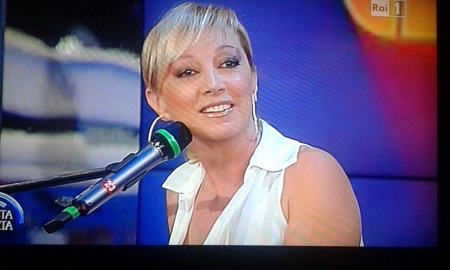
You have interpreted so many musical styles from pop music, jazz, soul, R&B;, blues, dance music to the Neapolitan song. What kind of music do you prefer?
Forte: I like music all! When a song or a song excites me regardless of the genre, that's the most important thing for me. So the emotion that music transmits to me, I repeat, regardless of any kind. The Neapolitan or Neapolitan music conveys great emotions to me. I repeat to you Mariateresa the emotion is the main thing for how much art music is done especially
Participation in the Sanremo Festival in 1991 with “It’s just a song” and in 1992 with “It’s nobody’s fault”, what did it represent in your artistic career?
Forte: For every artist, like me, Sanremo represents a great emotion and is an important point, it seems a point of arrival, but in reality you never get anywhere you do not end (as the great Eduardo de Filippo said) the “exams never end”. It is an important showcase, the most important we have in Italy, regarding light music the Festival of Sanremo; I hope that it lasts long and forever.
It is a great emotion and here is an important stage, one of the many stages for an artist, for a person who sings, who makes music and who wants to express
“Parapolitan or Neapolitan music conveys great emotions to me”
You participated in the TV show “Tale Quali Show”, where you represented an added value with your performances. What are the greatest difficulties you have had to achieve the extraordinary result achieved, such as in particular the imitation of the great Mina and also the imitation of Liza Minelli?
Forte: The difficulties are so many, because when one is not imitator does not have a technique and does not know where to go to lean and it is very difficult, especially when one is a singer with a personality, with a timbre of voice, so having to change, in short, it is very difficult. So all of us who are there and who participate we rely on the various coaches -(in my case were Maria Grazia Fontana and Emanuela Aureli)-, they point to you and give you the key then all the rest is yours. The difficulty is huge!
The path and ideas
In Sanremo we saw young people coming from the various talent shows. According to Rita Forte, are these talent shows a box of conformism or are they a path to incite young artists to arrive at the peak of success? What is the “talento” for Rita Forte?
Forte: Oh, well! Talent is an innate dowry or you have it or you don’t have it! So there is no school and no kind of study that can make it talented. If you have the talent, you can go to school to perfect yourself and it is essential because without the study talent alone is fine but, in short, it is right to study on for talent and to consolidate it.
As for the talent, the talents are the transmission of the moment, there are some fashions rightly of the various historical epochs of life in all sectors; now, instead, it is the period of talents who are programs, from the TV standpoint, that respond to a great success and work and that from the advertising point of view, as you have said rightly, of listening and good that exist.
And it’s a way for young people to get acquainted; in the past there was Castrocaro and there were the record companies where they were auditioning at the “good”, in the sense that an artist does the audition not in front of the camera but there were other ways to be able to express themselves; now there are these TV programs of great success, but the only thing is that the young people are so many; those who come out “UNO SU MILLE” (successful person
So you have to have a family, in my opinion, because they are young people, a friend who supports you, and always stay on the ground because then you find yourself pointless in white ( suddenly) at the apex of success without having done a proper and proper “preparation”, which serves everyone serves and is served to the great actors and great artists, because there is art, the world and the gift you can not have from that thickness that experience.
It seems a bad word, but in short it is experience and without experience you go nowhere that is danger
In the talent The Voice of Italy we witnessed the victory of Sister Cristina, a nun from Palermo who presented himself at Blind Audition with the cover of Alicia Keys “No One” and entered the group of J-AX and won. With the victory of Sister Cristina, can music join a fideistic attitude and at the same time can transmit messages of hope?
Forte: I'll tell you what I said before, music brings emotion. If it is a nun that brings emotions or if it is a young or common boy does not matter; the important thing that music transmits positive emotions if Sister Cristina has transmitted it was very good
“I repeat to you Mariateresa the emotion is the main thing as art and music are done above all”
You were discovered by the great master Luciano Rispoli in the transmission “Tappeto Volante” aired on Tele Montecarlo (current La 7). What memories do you have of that experience of “Tappeto Volante” and what artistic and life teaching did Luciano Rispoli give you?
Forte: ” I have extraordinary memories. In fact, I will never forget. Luciano Rispoli (as I call him Uncle Luciano) was the one who launched me and gave me the chance to realize a dream and taught me a lot. He really taught me so much, humility in doing this job, simplicity and gave me this great opportunity; he probably understood that in me there is that talent we spoke before and therefore I can not forget. So it was my slumber, and I said everything.”
What are the models you have inspired to become a great artist?
Forte: I tried to be myself and not imitate anyone because imitation is a bad copy of the original anyway. I listened to a lot of music; when I was a child, I listened to Mina and Barbara Streisand and I tried to sing their way, sing, express and try to have the technique. I closed my eyes and tried to be myself
Inspirations and references
What is the soundtrack of your life and professional journey?
Forte: There are so many. I was born in the 1960s and therefore there is no particular soundtrack. Yesterday evening (August 13 concert in Roccaraso that I did and that you have seen and I am grateful) I sang “I who do not live” a masterpiece of Pino Donaggio of the Sixties. As I said last night and as I always say in my concerts I am lucky because I have more than one soundtrack and are many songs that have marked my life
Who would you like to thank for your personal career? What will your future projects be?
Forte: ” My mother Luciano Rispoli who taught me to make music and were my lazy and then all those people I met and I learned so much from them in my artistic journey. I don't have any future projects, but right now I'm dedicating myself to the theatre and I know that you're studying theater and I wish you to reach that talent I've talked about before. And I thank you for this beautiful interview.”
