“the power, harmony and rhythm of horses and the soul of women according to jullo roberto”
Who is dedicated to
Roberto Di Jullo
- Ambito
- Artist and artist
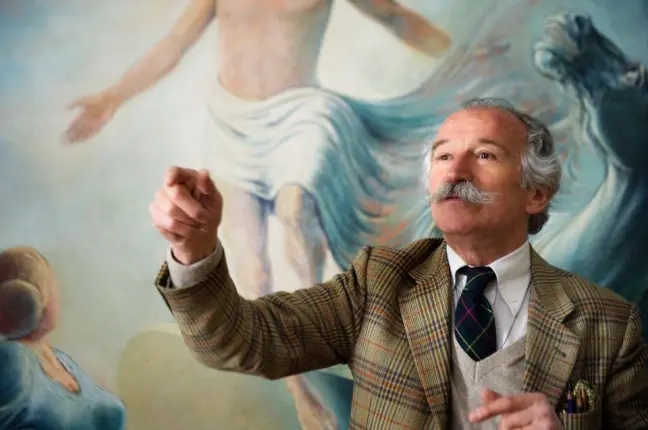
Dear readers of the “Voce del Paese” and of the “Casamassima Web” I had the opportunity to know a very artistic person very closely. I have known him for many years in Pescocostanzo (Aq) where I often go on summer and winter holidays. He is a person, in addition to being artistic, very genuine, estroverse, nice and above all an excellent painter. It is so, the “Pittore dei Cavalli” because Professor Roberto Di Jullo was known as the one who outlined and drew those tender and beloved animals: the sweet horses that manage to fix the soul, the substantial origin and the biology of the movement.
Not only Di Jullo was the painter of equestrian works but he wanted to emphasize another figure that told his story, his dreams and his regrets: that of the woman
Here is my interview made on 31 August this year to Professor Roberto Di Jullo.
1) “Jullo Master, when did you start painting and drawing the formation and structure of the horse?”
“I had the opportunity to have been invited to an exhibition on the Abruzzo’s major plateau in Rivisondoli where there is a large horse club and the owner asked me to present equestrian works something that I have never interpreted until now; so I had the need to document on the topic and I started drawing different groups of horses, to analyze the anatomy and what else can be useful and presented in this exhibition. The success is evident and they also asked me to present other personal horses and from there my history with the horse began”
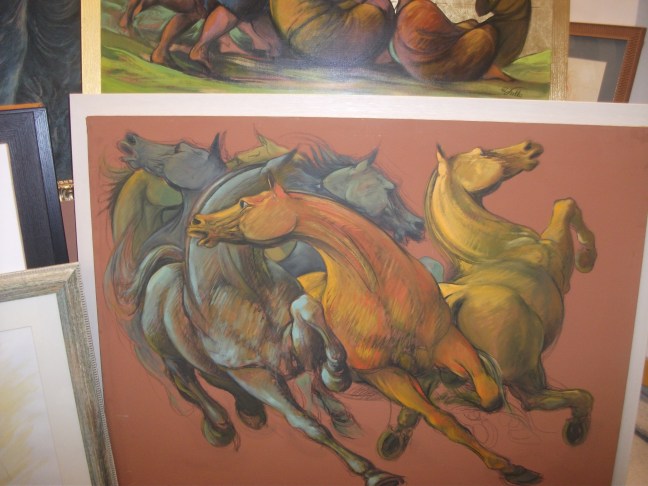
2) “Professor what are the allegorical values for which he wanted to emphasize the figure of the horse?”
“The horse, however plastic, noble and elegant, can be interpreted by the public in various ways; but I think it is simply a way of expressing the freedom, strength and the plastic power of this well-built animal and well capable of being graphically and pictorially projected. It is obvious that many can attribute complexes to me, always dealing with the horse, but there is nothing of this. I could only hardly say that it is narcissistic to represent it because it could represent man compared to the other theme that goes hand in hand with the theme of the horse: that of the woman”.
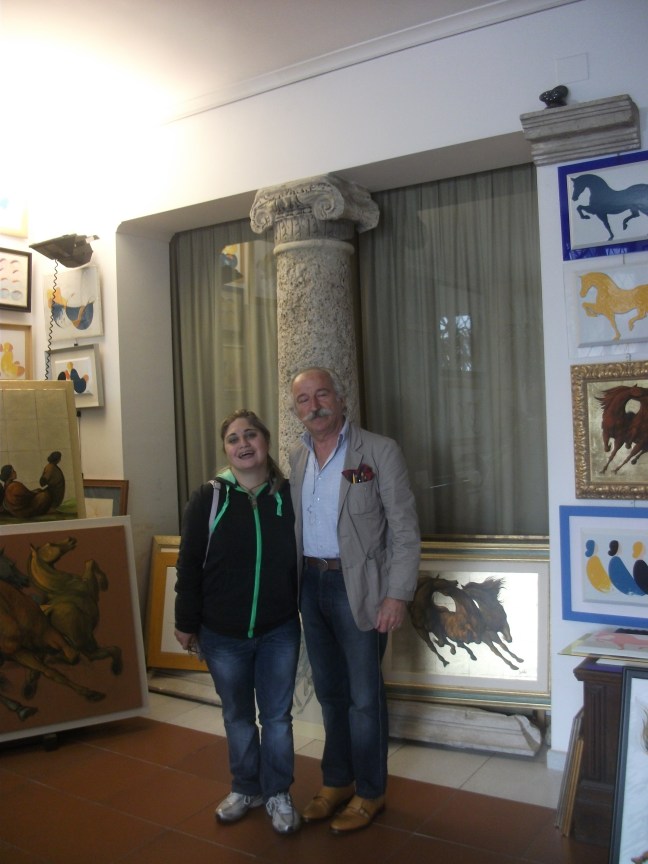
( MARIATERESA L'ABBATE IN COMPAGNIA DEL PROFESSORE ROBERTO DI JULLO)
3) “By reading many brochures, especially his interview on the Corriere della sera, she sieved as follows: << In horses there is power, harmony and rhythm > >. What do these three nouns mean in his paintings?”
“The power is evident and it is the machine that has accompanied man throughout history. The rhythm is part of elegance and so, as I said before, of horse construction and if the horse was a lower animal of limbs (such as a hippopotamus, a rhinoceros) do not have the same elegance as the horse. Harmony is that balance that is given to form in the general context of a construction of a painting that can in the concitation of movements to remain pleasing to the eye without having any forcedness.”
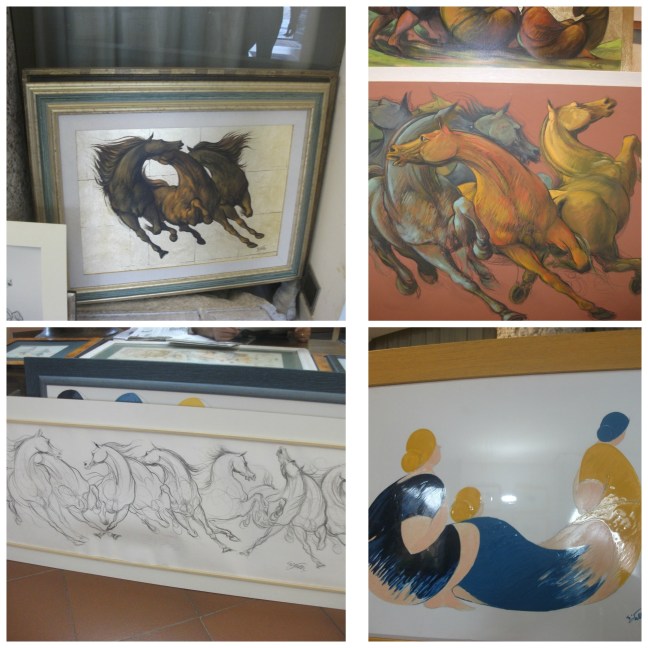
(some paintings by Professor Di Jullo exhibited in his gallery in Pescocostanzo (AQ))
5) “Another question Professor: in addition to the figure of the horse, she drew another subject to her very dear: the female figure. Who is the woman for the master of Jullo? How come he has valued the head, the female body and the legs, and what meanings express?”
“One of the first subjects I treated was the female figure, then the landscape and then in 1973 comes out this topic so present in my work that was the horse. The woman assumes the important position because she has also taken on the research started from the most since 1974-1975, where stylistically disviscerning this figure, I have expanded it to obtain ovulary and roundish forms within which I have enclosed the concept of the woman. So it is a life container and therefore, as far as my form is concerned, it is the final form to start life again”
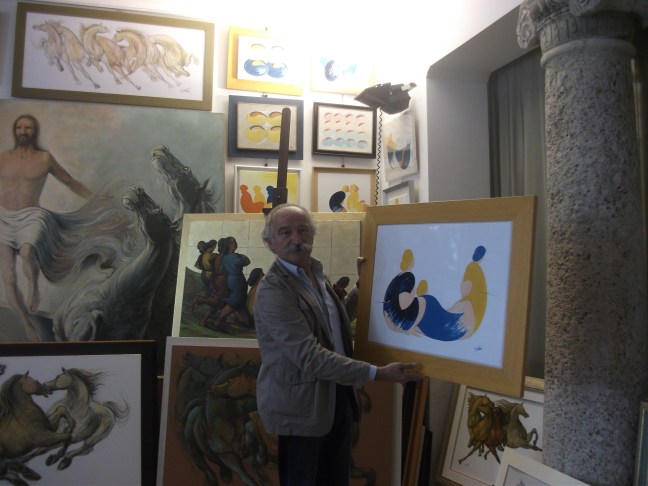
(THE MAESTRO DI JULLO WITH A HER QUADRIES: THE FEMMINILE TEXT)
6) “Last question: between the two important themes of his painting, what is his favorite?”
“Unfortunately as I said before, the woman assumes the primary importance, while the horse is an expression sometimes that I think narcissistic, that is, of this proruptive elegance but nevertheless that sums up in the easy reading, because the horse even arrives before these forms that I have been looking for for for for for 40 years.”
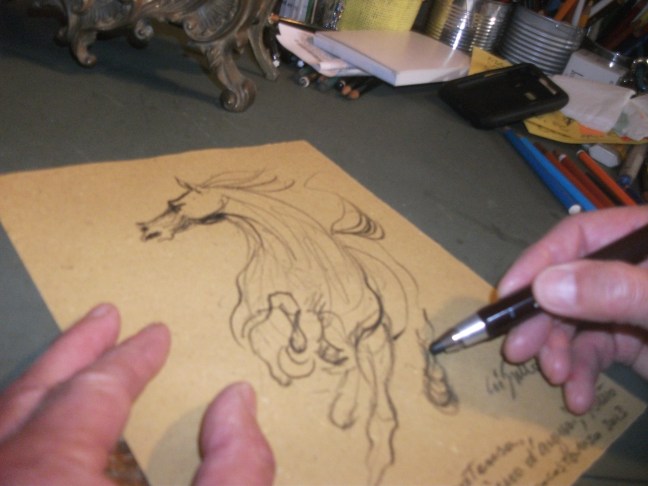
(THE DEDICAN OF THE JULY PROFESSOR TO THE OUR MARIATED GAMES THE ABBATE: A DIRECTLY A DISEGY TO MANO REFENDING A CAVALLINO DI AUGURI)
From my meeting with the master of Jullo, I realized that his art is not only pictorial but it is something extraordinary beauty and noble. His paintings express the harmony, perfection, strength, sensuality and sensitivity of everyday life. Indeed, in his paintings there is all the tumult that animates and vitalizes the world around us and that the Master Di Jullo tells us by adding the spirit that animates. When I entered the gallery of the master of Jullo in Pescocostanzo, I tried a sense of fun but also of reflection; in fact, seeing, for example, a picture of his horse I imagined to be surrounded by a quiet, clean and powerful world.

Editorial notes
- Text classified as review, distinct from interviews.
- Keep the original text and tone; remove extended lanes and bold, with paragraphs made more legible.
- No phrase added or reconstructed as the artist’s statement.
- Unconfirmed biographical dates have been omitted.
Points to check
- 10 quotes in the original text without a verified punctual source.