
The comedy and strength of the theatre — Interview with Lia Cellamare
The voice of this interview
Lia Cellamare
- Profession
- Actress and Comedy
- Country of origin
- Bari, Apulia, Italy
Lia Cellamare, actress and comedian, is at the heart of this conversation about the theme: the comedy and the strength of the theatre. The dialogue retraces experiences, choices and reflections that emerged during the interview, leaving room for the guest’s voice.
The beginnings and passion
How did your artistic career begin? What was the world of comedy theatre and cinema for you?
Cellamare: I began to be an actress in 1991, since last year I have been 25 years of artistic career (this year I am 26); and here I started a girl and now I am growing.
I have made this experience in the theatres of Bari, then it has arrived “You know the last?” and this year it is 20 years (from 1997 to 2017) and now I’m making the fiction with Vanessa Incontrada, with Giorgio Pasotti, with a star cast with an actress who made Gomorra and Leo of the Bracialetti Rossi, interpreting in this fiction the part of a teacher of Vanessa Incontrada’s son, they are of the Carabinieri and there many of the weapon of the Carabinieri.
The production is important and is that of the “Palomar” (the same production of the “Braccialetti Rossi”) fiction and we are turning, therefore they are turning on the territory of Puglia, and therefore thanks to the association “Apuglia film commision” give the possibility to make this union between Apulia and Roman artists work. Did you tell me what the world of comedy theatre and cinema has been for me? Two different worlds are for me.
I hid comedy, but in the cinema they know me as more dramatic parts so also comedian can make dramatic parts
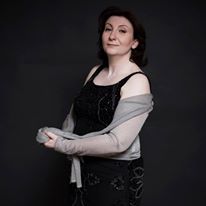
We have known you as “Dramacorda” the domestic woman of the sitcom “Very strong family” and also joker in “Do you know the last one?
Cellamare: And theatrical comedy actress in “Zelig”, but also protagonists of many films. Among all these characters you played in the cinema and the theatre, What is what you have left in your heart? What are the attributes that characterize it?
“Then they are all as children, so no one is excluded; every one from the smallest to the first thing I have done and until the last because they are the same loves, they are the same energies because when you interpret, however, you love a character, when, then, the production closes a project and you put on another. I have no preferences, it is important to love them and to achieve them and, therefore, to prepare for a next project”
Do you feel like a comedian actress or a dramatic actress?
Cellamare: I feel both because in fact and as if I could, easier for me and I have the comic ropes (so I laugh), however, also the dramatic part is as if I drove the bike to the missile then in the middle there is the machine and then when a complete actor can do so many things, others can be born with driving the bike, others, instead, are born driving the missile, others are complete and can do also on foot and so they can easily go from the bike guide,
“In the cinema the dramatist is called a screenwriter, and in the theatre the dramatist is the person in itself, that is, the author of the theatrical texts and in the cabaret is the same thing”
In the Commedia dell’arte, the greatest exponents were Plauto and Terenzio, the actor is the creator of the messincene and is sometimes in tune with the playwright. in theater and cinema, the relationship between the playwright and the actor becomes more and more sympathetic or are there discords between both sides?
Cellamare: In the cinema the playwright is called a screenwriter, and in the theater the playwright is the person in itself, that is, the author of the theatrical texts and in the cabaret is the same thing. I do as sports, the player must have a good ball, and so the ball can or not inflated well is the part of the playwright, while the player is the part of the actor.
In fact, in English, the actor is called “the player” and is the same as the player, because the actor is the one who does an act while the actor is the playwright, that is, the writer is the same.
It seems that the actors are like singers or singers who can sing or write their own pieces, the same thing we can see in the theatre or in the cabaret when someone likes to write or do them; but for the cinema and for the theater it takes the one who writes the text, like Shakespeare, then there is the director and then there are the actors who have to perform that piece like the song
The public and the language of comedy
The Pirandellian theatre is based on the poetics of humor (<>); it (the poetics of humor) has made a distinction between person/character (mask), stating that the character is the mask that recites the part dictated by society and that produces the verosimile. Your theatre (ironically we call it the cell-marian theatre), even in cinema, is combined with the poetics of humor of the Pirandellian theatre? [GROANS]
Cellamare: Well, yes! In the cinema, now, it is like in the neorealism of Vittorio De Sica of 1900 (in the neorealism that took society); but now these fictions and modern things lead to the actor to see reality.So the actor impersonates himself in the weak person, in the strong person, in the sick person; therefore, reality is not that much. I am very characteristic, that is, the actor who does an act then the characterist is the one who puts the character (the soul of a character).
So, I, as the great characters were Robert De Niro, but also our Italians as Alberto Sordi, Aldo Fabrizi (in ancient times in the 1960s) interpreted, and therefore characterized, and, therefore, gave a particular color to that character. So, in the theater, that mask, put on the face and we, then, give body
What is the difference between fiction and sit-com?
Cellamare: Well, they're two different genres. The sit com, in English, means “comic situation”; the fiction means “fining” and has a more dramatic part, instead sit-com or commedy is understood as “the stuff a little lighter” is a comic genre, while the fiction is a police genre, serious, dramatic and tragico-comic and leads you to a moment of unreality; therefore, they are two completely different genres
Among all the directors you've met in your artistic career, What is what you have left in the heart with which you would like to work again?
Cellamare: ” I had the pleasure of having local directors, that is directors of our private televisions (Antenna Sud, Telenorba). I was pleased to work with Gennaro Annunziante. He was born with us Checco Zalone (in art Luca Medici). I also did national works, where I also met Giovanni Veronesi who came to Puglia to direct the film “A woman for friend”. They are very precise and also these directors Rai. In fact, I'm working on this fiction that will be going on Rai 1.
But I had the opportunity to meet Luca Miniero and Paolo Genovese, who are two great directors, but I had previously made an advertisement, because many directors currently important that have filmed films have also made a lot of advertising, and I had the opportunity to make an advertising spot shot by Paolo Genovese Luca Miniero who is that of the “Banca Popolare Cooperativo” shot in Barcelona in Spain and I would still like to work with them.
“I’ve been taught, of course, fame because the visual medium because compared to the theater times, even the number of viewers, at the cinema puts millions of viewers going to the cinema and see the cinema”
Have we known you as one of the protagonists of Zelig and Do you know the last?. What did Zelig teach you and Do you know the last??
Cellamare: “They are two different genres, the joke is a comic time and ” Zelig”, cabaret is the same thing; only that the cabaret are unpublished texts, while the joke is not known from where it begins and therefore we have the great masters like Gino Bramieri and Walter Chiari, and then “You know the last?” takes jokes of those times, while “Zelig”, like the new television frontiers (now
The jokes are not already as pre-established as the merendine packaging is already closed or as the cake you make at the moment. These are the two differences. They taught me, of course, notoriety because the visual medium because compared to the theater times, even the number of viewers, at the cinema puts millions of viewers going to the cinema and see the cinema.
Now I’m doing “Christmas dinner” with Laura Chiatti and Riccardo Scammarcio with the direction of Carlo Ponti taken from Bianchini’s book, and so there are so many people. If, instead, Mariateresa, do theatre and stay in a city theater or even province, how many places are 100 places, 200 places etc.. How much theater do you have to do? how much life you have to do to reach those millions of viewers who see you on television not in cinema is different.”
Inspirations and references
What are the models you have inspired to become a great actress?
Cellamare: “The models that I have been espoused, as a child, were Giulietta Masini (a partner for many years of the unforgettable Romagna director Federico Fellini) and Anna Magnani and also Monica Vitti. Also dramatic actresses but who then have a comic artistic vein.
But also to see so much silent cinema (like Charlie Chaplin), also Stanli and Oil, so they are mechanical expressions because the joke, the comics and the number 3 that is a perfect number because there is the opening, because there is the part then there is the closed and then the 3 (the beginning, the middle and the closed) and therefore are 3.
What is the soundtrack of your professional personal journey?
Cellamare: My soundtrack was Memorie sung by Barbara Streisand which is a really exciting song that makes you walk
Who would you like to thank for your professional personal journey? What will your future projects be? Who would you like to thank young actresses like me to pursue a theatrical career?
Cellamare: ” Now I finish the fiction and then I move to Rome to stay close to nationals (the Rai) and other theatrical projects, as well as to do the hotel course and I am taking a second diploma of chefs.
I want to thank my parents who have always accepted me and they told me ok and so and it's okay because my mom was packing every time I came back down and then called me north, and so we lived in the train bunks because unfortunately Italy is long and where there is now work down in Puglia; you know how many times we have done the auditions going to Rome, in Milan we took the trains and flights to go to make the auditions.
The advice I would like to give so much study, so much patience and so open-mind”.
I conclude this interview by mentioning one of the answers given by our bare actress: “So the actor impersonates himself in the weak person, in the strong person, in the sick person; I am a characterist, in the sense that the actor who does an action then puts the character, that is the soul of the character”. I add to this statement of our artist, that each of us carry a veil of drama and comedy.
The actor is the creator of the stage representation and, when he communicates with the public and with himself, leads to the apex of the soul of that character he is interpreting. So, as actress Lia Cellamare said, “every actor wears a different color in the soul of his character”. I conclude by saying that the theatre is the fruit of the relationship between the actor and the public.
