The theatre and voice of the soul — Interview with Giuseppe Guida
The voice of this interview
Giuseppe Guida
- Profession
- Actor and comedian
- Country of origin
- Apulia, Italy
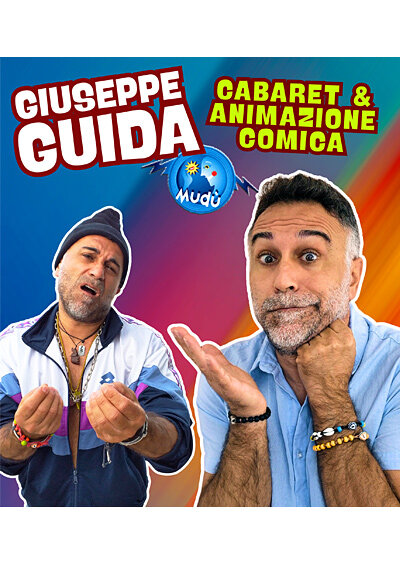
Actor and Apulian comedian, Giuseppe Guida tells his first steps in acting and the relationship with the public. Dialogue passes through the work on characters, the meaning of humor and the themes that you choose to bring to the stage.
The beginnings and passion
Theatre and cinema can give voice to art and soul, transmitting emotions to the public. Is that so for you?
Guida: “Surely! Both can convey a wide range of human emotions and experiences that speak directly to the soul of the viewer.
Theatre and cinema allow to tell stories and explore deep and universal themes. On stage or on screen we can invite the public to reflect on human experiences, showing the world through the look and sensitivity of the actor.
Their strength lies in the expression of emotions, narrative and creativity: tools that help us understand human experience and get in touch with our essence.
What were the first steps in acting? Was it a choice dictated by the case or passion?
Guida: You're not gonna believe this, but I was very shy as a kid. I found out almost by chance that playing a different role than I really was making me safe and made me unlock in front of the people (the spectators in that case), which I couldn't do in real life.
Also you have to know that since I was a child I had an idea of the world, indeed I would say more than anything else a dream/desidery on my part, in which everyone was friends with each other, they respected themselves as brothers, they were not harmed... in short: they were happy and cheerful!
Becoming a teenager I made the bitter discovery that all this was not part of the real world that contributed significantly to bringing me closer to the theatre, to the recitation, especially to comic art, to make sure that I was the “dispenser” of that happiness and joy that in the world, and in the great daily happenings, I could no longer see, find perceiving.
At that time, the idea was taken in me that my mission would be to bring joy, happiness and carefreeness among people so as to “hold alive” my dream/desidery that I cultivated since I was a child.”
“Theater and Cinema are powerful tools to tell stories and explore deep and universal themes that concern the human essence”
The Pirandellian theatre is based on the poetics of humor (sense of the opposite); it (the poetics of humor) made a distinction between person/personal (mask), stating that the character is the mask that recites the part dictated by society and that produces the verosimile. Is your theatre (ironically we call it the “Guidian” theatre) combined with the poetics of the humor of the Pirandellian theatre?
Guida: Domandina bella “tosta” on a very interesting topic that you can not easily enclose in an exhaustive way in a written answer of a few lines... I still try, trying not to stretch out...
Yes, my comedy, but more generally the comedy of a comedian actor, can definitely approach the poetics of humor in the theater of Pisa, although, in my opinion, in a more complex and faceted way... I explain...
The comic actor could embody a character who, although apparently comic, hides under the mask a complexity and a psychological depth that contradict its apparent comedy. This creates an irony and dramatic tension that are characteristic of the Pisan poetics.
The poetics of the pyrandellian humor are based on the concept of “sentiment of the opposite”, in which the tragic and comic, the serious and the ridiculous, intertwine and overlap.
The comic actor could embody this feeling of the opposite through his interpretation, offering the public an ambivalent vision of his character: it could be funny and grotesque superficially, but, at the same time, “under the surface”, “behind the mask”, could emerge nuances of pain, vulnerabilities or contradictions that make it more human and complex.
Pirandello also claims that what is represented on stage is not the reality itself, but only a fiction created by society and accepted by the public. The comic actor (but also the actor in general), could question this illusion through his comedy, breaking the fourth wall revealing to the public the conventional artificial nature of theatrical representation.
In conclusion, then, the comedy of the comic actor can be combined with the poetics of humor of the Pirandellian theatre through the challenge of theatrical conventions, the questioning of social masks and the creation of complex characters that embody the “sentiment of the contrary”.
Do you prefer to play roles suitable for your person or away from your being?
Guida: On this question I will be very brief: surely comic characters far from my being! To create a character away from my being, the “journey” to undertake is undoubtedly much more fascinating, as well as complex and difficult I love the charm of difficult and complex challenges“
“Teatro and Cinema continue to be important channels to explore the complexity of human experience and to connect with our deepest essence of human beings”
The path and ideas
What themes are more at heart and how do you deal with them through irony?
Guida: I've dealt with so many topics that I've told and staged in comic key, the most important ones and to which I was particularly concerned, are the following:
1) Politics, prevarication power of the weakest. The political dynamics of my satire and comedy highlight the contradictions of the Italian political system. This also allows us to reflect on the dynamics of power on the importance of having honest and responsible politicians who are truly dedicated to the problems of citizens and, above all, solve them.
2) Technology and digital dependence. The dependence on technology and social media is a topic that I have ironically treated to reflect on its impact on society. People's lives are now completely dependent on their digital devices and this makes the absurd situations in which they are found easily due to this dependence.
With my comedy related to this theme I made smile but I also tried to make it reflect on the need to balance the use of technology with a real quality life.
3) Man/woman relationship and couple life. I am currently teasing my show in which I address a theme dear to me: the theme of engagement and marriage, referring to sympathetic and fun anecdotes of my couple life, to my loving misadventures during engagement, to the hilarious character incomprehensions between man and woman during the path of my marriage life.
All (or almost!), men and women, end up reviewing and recognizing themselves in what I tell on stage in a comic key and this makes the rice flow spontaneously, natural overwhelming among the spectators.“
What is the “rice” and what is fundamental in comedy?
Guida: “In comedy, rice is fundamental because it represents the positive response of the audience to the ability to be fun. Comicity is based on the ability to arouse rice in others through various techniques, such as the creation of hilarious situations, the use of witty jokes, the game with words or comic gestures.
Essentially, comedy involves the ability to observe the world in an unusual or ironic way, we say from a “different angle” than that considered the “normal angle”, and to communicate this “new” vision in such a way that make others smile or laugh. The ability to understand what is fun to convey this sense of fun is therefore fundamental to create a good comedy. In this, of course, the experience of comic actor plays a key role“
Who would you like to thank for your professional personal journey? What are future projects?
Guida: I must first thank my maternal grandmother, Anna, who is no longer there today, and who has always believed in me has always supported me in everything I have done in the world of Art. Then my parents who never hindered me in this. Then again the regrettable and unforgettable Gaetano Porcelli who allowed me, in the dress of a comic and brilliant shoulder, to move the first steps in the world of comedy thanks to the comic duo “i Cipsters”, which he wanted to create with me in 1991.
The artistic partnership between us lasted until about 2005, then the serious evil that plagued him, slowly, if he took him away... He was the comedian, I was the shoulder. Gaetano, like me, in the early 2000s, took part in the first editions of the Mudù of Uccio De Santis on Telenorba.
Finally I have to thank the shy little girl and dreamer that I was in youth: without that shyness that I wanted at all costs to win without that desire to dream a more beautiful world, today there would be no Giuseppe Guida atore comeo“
